Wednesday, February 25, 2009

Barcelona I - Gypsy Pickpocket


We arrived in Barcelona on Sunday night and have been having an incredible time. There are tons of great sights to see and the food is absolutely incredible. On the negative side, I (Jon) was almost pickpocketed today on the subway!

Kristi and I were riding the Metro on the way to La Rambla when a girl (around 18 years old) walked onto the train carrying a jacket on her arm. She then started to push her body against mine and inched closer and closer to me (on a somewhat uncrowded train). I then felt a hand very close to my body and then inside my pocket. Now, while the above chain of events likely would have been a turn-on to a single man and could have resulted in a date (or more), as a happily married man, I was not interetsed in a game of pocket pool and I became quite concerned. I slapped the girl's hand and she quickly exited the train. I then yelled out "pickpocket", but she had already departed the station. While I can only assume that she was a gypsy, this conclusion is a bit stereotypical, so I can only state that she was around 18 years old and not of high moral standards.

I would also like to send a direct message to this would-be pickpocket (I don't believe that she has subscribed to this blog but figure that there is a small chance she reads it).
GYPSY (OR GYPSY-ESQUE GIRL): DO NOT TRY TO PICKPOCKET ME AGAIN. THIS WOULD REALLY PISS ME OFF AND CREATE A LOT OF UNNECESSARY STRESS. IF I SEE YOU AGAIN, I WILL CALL THE TRANSIT POLICE AND YOU WILL NOT BE ABLE TO ESCAPE. WATCH OUT!!

Otherwise, all is well and we will keep everyone updated on our Barcelona adventures.

Cheers,

Jon

Monday, February 23, 2009

Organic Farming in Spain

After a lot of exciting travel through Portugal and Spain, Kristi and I decided to settle down for a week with some old fashioned manual labour. When we envisioned this trip, we always wanted to include some kind of interesting / different volunteer experience and there are several organizations that help facilitate farmstays, which basically provide free room and board in exchange for 5-7 hours of manual labour (daily). We found this farmstay through Help Exchange.

Our farm was located in the foothills of the Sierra Nevada mountains, about 10 km from the Mediterranean Sea (approximately 20 minutes from Orgiva, a small town).

We were close to 3,000 feet above sea level, so needless to say, there were incredible views in every direction.

The farm we stayed at was owned by a Brit who had moved to Spain from London about 5 years ago in search of an easier life. His property is over 40 acres and is currently scattered with olive and fig trees, but he is in the process of digging / planting beds to grow vegetables. Since we were basically unskilled labour, our main job was going to be to dig a giant bed. Since the property largely consisted of rocky hillside, we had to sift through significant amounts of weeds and rocks during our digging, so it took us all week to dig a bed that was about 30 x 25 feet. It was actually very refreshing to be outside in the fields all day and while we were both extremely achy each morning (especially Jon), our Tiger Balm (purchased during the honeymoon) came in extremely handy.

Outside from our laboring, we loved hiking in the nearby mountains (although one 5 km hike turned into a 15 km hike after a few wrong turns) and we also loved the food - our host was a great cook and always managed to keep us full.

Outside of all of the activities, Kristi and I definitely loved playing with the 3 dogs on the farm, Patch (pictured above with Kristi), Saff and Rocky. They definitely kept us smiling and entertained the whole week.

Following the farm (additional pictures available here) we traveled to Granada for a long weekend (post to come) and are currently in Barcelona until March 5th.

Thursday, February 19, 2009

Seville III - Sports


Thankfully for Kristi and I, Seville is home to several major sports teams including basketball and two football (soccer) teams. Given how much we enjoyed the basketball game in Berlin and football match in Porto, we definitely wanted to see both in Seville.

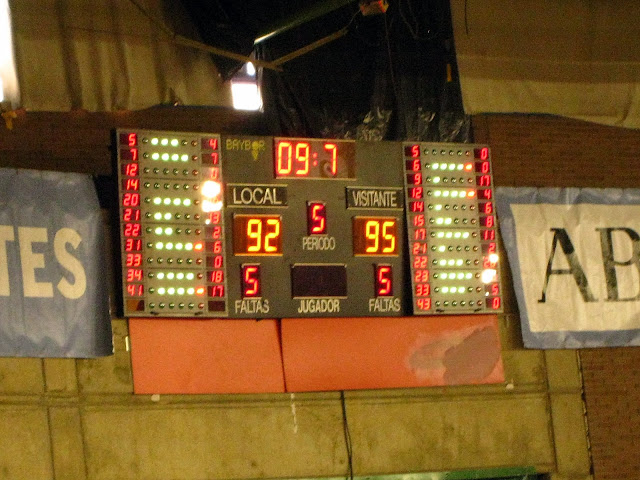
Seville's basketball team, sponsored by the local bank Cajesol are worse than the Raptors this year, with a record of 4-17 and expected relegation next year to an inferior league. However, when we saw them play Real Madrid, they came out in full force and took the game to double overtime before lowing 95-92. As you can tell from the sepia photo at the top of this post and the scoreboard above, this was a different experience than the NBA or even the O2 Arena in Berlin. Cajesol Sevilla plays in a small, 7,000 seat gym that is part of a large athletic complex about 15 minute from the city centre. While the facility was built in the 1980's, it looks like the basketball arena was built in the 1950's and hasn't been updated since. This is what Kristi and I thought an early NBA game would be like, with no Jumbotron, a very basic scoreboard (above) and concessions sold from folding tables outside the arena. Also, because the team is so bad this year they give away a large number of tickets for free to each game. Thankfully, that led to a jam packed arena and a really loud crowd, an asset to any sporting event. The free tickets also brought out a lot of families and teens, a rarity for basketball/hockey in Toronto when tickets are priced out of the range of most working families.

Also, Seville's team mascot is a bull, consistent with the bullfighting that is common in Spain (there is a 15,000 seat outdoor bull fighting arena right in the middle of downtown). This bull looks quite different than Chicago Bulls mascot Benny the Bull, but still, this seems like a knee-jerk reaction to the success of Michael Jordan and the "real" Bulls in the 1990's.


For those not that familiar with Spanish baksetball, the main league (the ACB) is said to present the highest level of competition outside of the NBA. We thoroughly enjoyed this game, including loving every aspect of the old-school arena, sitting in our free seats, eating sunflower seeds with the rest of the fans and cheering for the local team (and their horrible uniforms). We are definitely going to try to attend more ACB games during the rest of our Spanish adventure. PS: For those of you interested, the best player on the floor was Louis Bullock of Real Madrid.

Following the success of our basketball adventure, Kristi and I definitely wanted to make it to a football match during our Seville sojurn. There was a huge local derby taking place between Sevilla FC and Real Betis during our stay, however, tickets were too pricey and the weather was dodgy that day so we decided to avoid it. Instead, we decided to closely monitor the Spain v England friendly taking place on on February 11th and picked up tickets right when they went on sale for a very affordable 15 Euro apiece. Again, this pricing strategy (tons of tickets available from 10 - 20 Euro) may not have been profit maximizing but brought out a very loud and boistrous crowd filled with students and 20/30somethings. When Kristi and I showed up at the stadium before the match, it looked like we were joining a riot as there were beer bottles and broken glass everywhere, tons of people dressed in red and yellow cheering and a few brass bands wandering around playing some of the Spanish songs (not sure that the equivalent in Canada would be, but I just don't seem to think that "This Land is My Land" or "A Place to Stand a Place to Grow - Ontari-ari-ari-o!" would bring about the same passion.

As for the game itself, with the crowd on their side, Spain managed to outduel England 2-0 with the loudest cheers for Spanish hero David Villa as he scored in his 6th consecutive international match. The loudest boos (whistles in Spain) were saved for David Beckham, especially when he picked up a yellow card for arguing. He then continued to get jeered afterward everytime he touched the ball. The post-game celebration was a little bit tamer than the pre-game but definitely a great time.

Thursday, February 12, 2009

Cordoba

A few days ago, Kristi and I decided to take a day trip to Cordoba, which is about 1.5h by train from Seville (under 1h if you take the high speed train). Between 750 and 1200 A.D., Cordoba was the capital of Moorish Spain and one of the leading centres of Muslim art and learning. Cordoba's history also includes a very large Jewish population, which was decimated during the Spanish Inquisition.


Cordoba is best known for La Mezquita, the astonishingly large cathedral/mosque that stands at the heart of La Juderia, the old Jewish quarter of the city. The first iteration of La Mezquita was built by Abd ar-Rahman I, beginning in 786, on the remains of an old church. Subsequent rulers of the Spanish Moor empire added on to the building until it reached a capacity of 15,000 parishoners. La Mezquita is an architectural wonder as the interior consists of row upon row of marble columns, supporting perfectly constructed arches (seen in the photo above). When the Christians recaptured the city in the 13th century, they transformed La Mezquita into a cathedral, but thankfully did not destroy the original mosque. We were both mesmerized by the building.

Nearby La Mezquita, is the old Cordoba synagogue (above), one of only three that survived the Spanish Inquisition. The synagogue was built in 1315 and is extremely small (I would bet that it could hold a maximum of 50 people for prayers). A lot of the building was destroyed over the years; however, some of the original stucco and stonework remains, including some of the Hebrew text that surrounded the interior (as seen in the photo below).


We also toured a small museum nearby the Synagogue dedicated to the history and customs of Jews in Spain. It was interesting to compare some of the local customs to those practiced at family gatherings and on Jewish holidays in Toronto.

We also really just enjoyed wandering around Cordoba and seeing the city (additional photos posted here). It was perfect for a day trip and similar to some of the other smaller cities that we visited in Portugal. We had some great coffee and pastries, a light lunch and then headed back to Seville by train.

Sunday, February 8, 2009

Seville II - Convento Dulces (Convent Sweets)


Due to the strength of the Catholic faith in Spain, there remain many convents in the country and many nuns within these convents. In order to support themselves (beyond whatever stipend is given from the church and the local parish), many of these convents have branched out into other businesses, the most popular of which is baking and other sweets.


We are located near several convents and went out the other morning to sample these convent dulces and see how well these nuns could cook. Our first stop was Santa Paula, which is famous for its nineteen varieties of jam and marmalade. We were greeted by what may be the world's oldest nun, who would not allow me to take her photo in fear that the camera would steal a part of her soul (at least that is my translation, although I do not speak Spanish very well). At any rate, she led us into a very small room with a glass showcase full of jam. After a lot of deliberation, we decided to go with raspberry and lemon (pictuerd above).

Our second stop was much more interesting. we visited Santa Ines, which is located nearby our apartment but is more of an enclosed order where the nuns are not allowed to see the general public. Nonetheless, these enterprising nuns still run a busy baking business and have adapted the lazy susan (pictured above) to meet their needs. Upon entering the convent, there is a wall with the lazy susan, a price list and a buzzer. Instead of having to interact with the world's oldest nun (as at Santa Paula), you instead ring a bell which alerts the world's second oldest nun, and apparently despite not being allowed to see the public, she is allowed to speak with them. You let her know your order and within minutes, the lazy susan spins around and a new section contains your baked goods. You then place your money back on the lazy susan, it spins around once again and you are given your change. Obviously this hinges partially on the honor system, however, I'm pretty sure that these nuns do not get ripped off very often.

Thankfully, the nuns of Santa Paula and Santa Ines are great cooks and we have been enjoying our jams and cookies all week. We may pop into a couple of more convents to see what their specialties are and also to see if we can finally get one of these sisters to pose for a snapshot.

Seville I - Churros con Chocolate


We have arrived in Seville and are staying in a great little apartment in the Macarena district (unrelated to the 1990's dance craze of the same name). We have really enjoyed having a place of our own where we can spread out a bit more and cook, as opposed to being in a hotel room and having to search out 3 meals per day. We have especially enjoyed being able to have breakfast at home before getting ready for the day, although a couple of days ago we ventured out to enjoy one of the favorite breakfasts of the locals - Churros con Chocolate.


A churro is basically a fried piece of dough. Here in Seville, they come in straight stick-like pieces or spiral-shaped as demonstrated in the above photo from our local churreria (a place that specializes in making churros). They are generally served with drinking chocolate, which is a thicker version of hot chocolate and is the perfect place to dip your hot churro.


What is unclear to Kristi and I is how these churreria's stay in business. It seems like from a North American health perspective, churros con chocolate should be consumed at most once per month, but these places are always packed in the morning and often in the afternoon with relatively skinny Europeans enjoying these delicacies and staying thin. At any rate, we definitely will be over our self-assessed once per month allotment by the time we leave Seville as they are pretty addictive.


Thursday, February 5, 2009

Southern Portugal


On our way to Spain, we thought it would be fun to rent a car and drive through some of Southern Portugal, including the Alentejo wine region and the Algarve (although it wouldn’t be beach weather).

We began in Evora, a 1,000 year-old walled city a couple of hundred kilometres east of Lisbon. We had heard great things about Evora and the Alentejo region, specifically that it had the best food in Portugal and that the people were extremely friendly. Both of these were true. We stayed in an incredible hotel (above) that was situated in an old convent that had only recently been converted, and still housed an incredible 500 year-old chapel (that hosted Sunday mass every month). All of the food that we ate in the area was also incredible. The area is known for their meat and we enjoyed some delicious lamb, wild boar and beef (among other things) as we explored the region.


Being the food capital of Portugal, Evora is also known for their desserts. Pictured above is the regional specialty, egg yolk and sugar tart. We learned that this dessert, prepared by the nuns (to earn a few Euro), came about when the nuns found themselves with extra egg yolks after using the whites to starch their wimples. The nuns cleverly mixed the yolks with sugar, thus creating the egg yolk and sugar tart! The tart was simple and delicious - a perfect ending to a great dinner.


On our second day in Evora, we took a trip to the nearby town of Estramoz for their weekly farmers market. The market has a mix of vendors, including old antiques, produce, dairy (cheese vendor above) and live chickens (not on our shopping list).


We were specifically looking for some local cheeses to try and ended up finding a bounty. The cheese in Portugal is very inexpensive given the quality and artisinal cheese tended to cost 1-3 Euro for a small round of great local cheese. We went a bit overboard on cheese, olives and honey, which resulted in a great lunch the following day (pictured above).


After two days, we departed Evora for the southern coast of Portugal, the Algarve. Since this was offseason, we only planned a short stay in the Algarve, but if it had been May or later, we definitely would have stayed for longer. In our case, we had a great couple of days and really just relaxed and didn’t venture out too much. It was relatively sleepy in our area given the season, which was fine with us.

We didn’t know very much about Portugal and its various regions, prior to our trip mainly because we expected to be spending time in Israel (as opposed to Portugal) before the violence flared up. However, after three weeks, we have built up a bit of a knowledge base on the country and have put together a list of facts / idiosyncrasies about Portugal and the Portuguese.

1. While they are experts at preparing meat and fish, the Portuguese have no idea how to prepare vegetables nor do they eat enough of them (other than the ubiquitous french fry). Other than fries, the average Portuguese meal MAY contain a few leaves of sad-looking lettuce (undressed) and perhaps (if you are lucky) some broccoli that has been steamed to death. Gordon Ramsey would not be happy.

2. The Portuguese language is pretty interesting. If you try reading it, it looks somewhat like Spanish, which has many words that the English/French speaker can pick out. However, when hearing the spoken language, it sounds more like Russian than Spanish. Note that this applies only to the dialect spoken in Portugal. We met some Brazilians on our trip who also explained that the Brazilian Portuguese sounds more like Spanish and that they even had some trouble communicating with the locals.

3. Eggs and dairy in Portugal (and much of Europe) taste about 10x better than in North America. For those who have never visited a European supermarket, the eggs and milk are not refrigerated and milk only needs to be refrigerated after opening. The eggs yolks are more orange than yellow. Kristi and I attribute this to better living standards for the hens, but are not quite sure.

We didn't take a ton of photos on this road trip, but those not in this post can be found here.

Following Portugal, we arrived in Seville on Tuesday and have been relaxing in a rented apartment that we have for 10 days (we are really excited to finally be able to cook our own food). Looking forward to posting about some of the things we have been up to.

Cheers,

J & K

Sunday, February 1, 2009

Lisbon

One of the inspirations for our trip to Portugal was the recent resurgence of Lisbon. Despite being geographically located in Western Europe, Portugal had not experienced much of a cultural revolution over the past 20 years, like other capital cities. However, over the past five years there have been substantial changes to the city and it really has become an overlooked jewel.

Lisbon reminded Kristi and I of Buenos Aires, both in terms of the architecture, design and the friendliness and enthusiasm of the populace. Old neighbourhoods like Biarro Alto continue to gentrify and what used to be slums are now home to cool design boutiques, sneaker shops and bars serving mojito’s, caiperinha’s and the like.

We found a great little design hotel in the Baixa district, geographically downtown near the waterfront and close to many of the other sites and areas we wanted to visit (although pedestrian travel in Lisbon requires a lot of climbing stairs or walking uphill). Also, after relatively monotonous Portuguese food in the North, we were able to add some more international flavour to our diet, as well as experience some of Southern Portugal’s culinary charms, especially the simple but delicious char grilled fish.


One of the highlights of Lisbon was the Belem neighbourhood, a 15 minute tram ride west of downtown. Belem was the departing point for Vasco de Gama whose sailing exploits inspired a church, monastery and other monuments along the waterfront (pictured above).


As well, Belem is home to the waterside Tower of Belem(above) which was a strategic defense point for the city.


More recently, in 1960, a monument to Portugal’s explorers was built to commemorate the 500th anniversary of Henry the Navigator’s death (pictured above) and the Belem Culture Center was built in the past decade includes a modern art museum and several theatres.

Beyond its nautical history and contemporary art, Belem is home to the pantheon of Portuguese pastry, Pasteis de Belem, a bakery that was founded in 1837 and makes the best egg custard tarts in the world (pictured above). While there, Kristi and I not only were able to enjoy several of the tarts, but also watched busloads of Japanese tourists devour towering plates of these delicacies.

While this simple tart can be found in Portuguese bakeries around the world, the ovens at Pasteis de Belem reach super hot temperatures, resulting in extremely flaky and crispy pastry crusts, unlike those Kristi and have had ever sampled.


Along with exploring Lisbon, we took a day trip to Sintra (above), a 45-minute train ride westward and home to an incredible Moorish Palace and a well-restored hilltop castle.

Despite a rainy visit, we hiked about 4 km up steep and windy roads to reach the castle (above) and were able to enjoy great views of the surrounding area as well as the neighbouring Palace de Pena, a 19th century royal palace.

We were both thoroughly impressed with Lisbon’s renaissance and believe that it will continue to improve over the next decade, although along with the improvement, prices will increase and further gentrification may impact some of the city’s character. Additional Lisbon pictures can be found here. Our post-Lisbon travels include a tour of southern Portugal, ending in Seville, where we will put our feet up in a rented apartment and hopefully find time for some home cooking.

Jon & Kristi

Thursday, January 29, 2009

Northern Portugal

After a wonderful 5 days in Porto, we bid adieu to the city and took off by car to explore Northern Portugal a bit further. We wanted to track down some of the historical sights of Portugal and visit some of the vineyards that produce the grapes for the Port we so enjoyed in Porto.


Our first stop was Guimaraes, an incredible historical town that dates back over 1,000 years ago. We stayed at a great inn within the medieval centre of the city, which was part of a network operated by the Portuguese government. These inns are called Pousadas, and are located throughout the country, generally in historical buildings that the government wants to preserve but also utilize in a productive manner. From our Pousada (named after the local church, Nossa Senhora da Olivera) we were able to explore the town on foot, including the incredible 11th century castle (pictured above) and the Duke’s Palace (which is a lot “newer” as it was built in the 15th century). Both are a testament to Portugal’s long and storied history and the vast inventory of incredible palaces and castles throughout the country.


We were able to eat pretty well in Guimaraes, with the most interesting being a dinner at Cervejeria Martin, a local bar that is covered in scarves from various football (soccer) and other sports across Europe (above). What made the meal so interesting was that Guimaraes’ local professional volleyball team (Vittoria) was in the Euroleague for the first time and was playing against Moscow that night, a powerhouse of European professional volleyball. The bar was full of supporters and after we left dinner, the streets were quiet save for the sounds of spikes and whistles that we heard from every open door and window. We would have gone to the game had we known the draw of professional volleyball, but were happy enough to watch it with some fans.


Following Guimaraes, we left for the Douro valley - Port country (the actual vineyards this time, as opposed to the Port Lodges of Port). The whole region has been designated a Unesco World Heritage site due to the incredible way that the wineries are all carved out from the hills surrounding the Douro river (Portugal is BIG on letting you know that things are Unesco World Heritage sites - most countries don’t seem to think that this is a huge deal, but perhaps the poorer the country the more they cling to designations like this one). The drive along the local highway N-222 was definitely one of the most incredible car rides we have taken and Kristi did a great job handling some pretty narrow and curvy roads. We ended up in Pinhao, a very small town (population 300) right on the Douro and stayed at a local Quinta (winery) named Quinta de la Rosa. This moderately sized Quinta produces red wine as well as their own port (both of which we tried and both of which I believe are available in Canada). Since it was low season, we were the only guests at the Quinta. Weary of navigating the roads in the dark, we decided to self-cater, and we were able to find the best butcher in town (above) and pick up some fantastic cured meats and local cheeses to enjoy with some red wine and port for dinner. The weather was a bit patchy that night and we ended up spending most of the night by candlelight as the power flickered on and off - very relaxing and romantic.

Our last night of the roadtrip (prior to arriving in Lisbon) was in Coimbra, home to the oldest university in Portugal (second oldest in Europe) and a really fun, lively place. Our hotel was close to a huge wooded park (which was great for jogging) and equally close to the old part of town (which was great for sightseeing). The highlight of Coimbra for us was our dinner. The local restaurant we went to was full with a 25-person group of 30-something ex-students who were enjoying a reunion of sorts. One of them was a local from Coimbra who helped Kristi and I choose all of the house specialties for dinner. These included a dish of fried small fish (like smelts) which were incredibly fresh and served alongside acorda, which is a garlicky porridge made from bread and herbs, as well as the local specialty of chanfana, which is kid (young goat, tastes a bit like lamb) stewed in red wine (tastes better than it sounds). This was definitely one of our best Portuguese meals to date and somewhat redeeming for the country's cuisine given some of the other offerings we had seen in Porto and on our trip.

We ended the road trip in Lisbon, the beginning of a five-night sojourn. Post-Lisbon, we plan on taking a similar roadtrip through Southern Portugal (including the Algarve), ending in Seville where we plan to rent an apartment for approximately 10 days to relax, enjoy the town and enjoy some home-cooked food (we are extremely excited to cook with some of the local products and are a bit tired of continually searching for great restaurants, although we have found many).

The remaining photos of Northern Portugal can be found here (warning: these are a bit repetitive with tons of photos of the Guimaraes castle and the Douro wine region).

As promised in a previous post, it is now time for the Reader Mailbag, where we answer some of the questions from the inquisitive readers of this blog.

Q: How have you been surviving without a cell phone? Specifically, is Jon going crazy without his BlackBerry?

A: While most people figured we wouldn’t last more than 7 days without a cell (and that I wouldn’t last more than 2 days without my BB), we have managed just fine. It’s pretty relaxing not to be checking email constantly, especially after 6 years of being tied to it. Skype has also been a godsend as we can connect with home but also call hotels, restaurants, rental car companies, etc. for only a few cents per minute.

Q: Are you ready to come home yet? (asked several times by M & S Ellenzweig)

A: No. Return date is May 27, 2009.

Q: How many times have you done laundry? How much underwear did you bring? (we received the underwear question from 4 different people, which is a bit creepy)

A: Not sure why the readers are so concerned with undergarments, but we have done laundry a couple of times in our sink and went to a laundromat in Lisbon to do a full load.

Q: What books have you read so far?

A: Jonathan has read The Nasty Bits by Anthony Bourdain and Inheritance of Loss by Kiran Desai. Jonathan is nearly finished Extremely Loud and Incredibly Close by Jonathan Safran Foer (book is somewhat annoying but I will stick with it). Kristi is just finishing up McCarthy's Bar by Pete McCarthy, in preparation for our trip to Ireland. As far as other media goes, we have finished Season 1 of Mad Men and are part way through Season 1 of 30 Rock. We have also watched a few movies including Kristi's fave, Sex and the City.

We will resume the mailbag in a future post. Please continue to submit your questions to us via email or through the comments on this blog.

Before signing off, we also want to wish a very special 61st birthday to Michael Ellenzweig. Dad, you don’t look a day over 60.

J&K


Sunday, January 25, 2009

Porto

Having had enough of the cold weather, and our fill of beer and sausages, we headed south (and west) from Germany to Portugal. We arrived in Lisbon on January 16th, and took a train straight to Porto. We were welcomed with warmer weather, and heavy rains. But, in spite of the wet weather, we managed to keep ourselves dry and warm by taking in the local sights, culture and fortified wine.

On Friday, we went to a Portuguese football (soccer) game at Estadio de Dragao. FC Porto (the home team) took on Coimbra and took the match with a single goal in the second half. Fans were relatively tame, since the match was a cup game (as opposed to the regular season) - however the “supporters sections“ were as enthusiastic as always. In an effort to fit in with the crowds, we followed suit at half time and sampled what seemed to be the most popular snack - popcorn. Though not popcorn with salt and butter like we usually eat it in North America, this was lightly sweetened and crunchy, we quickly realized why it was the most popular snack at the game.

Traveling around town on Porto’s new subway line also helped to keep us dry as we visited two of Porto’s newest buildings: Casa da Música (above), and Fundacao de Serralves (Museu de Arte Contemporânea). Though we didn’t make it to a concert at Casa da Música (disappointing), we did tour the building from top to bottom, and were just as impressed as the Times critics who called the Rem Koolhas-designed building “insane” and “brilliant“. With two concert halls and tickets priced equally for any seat in the house, the building hosts a diversity of concerts from Fado (traditional melancholic Portuguese singing) to electronica.

The contemporary art museum at the Fundacao de Serralves is a minimalist building designed by a leading Porto-based architect, where exhibitions are the main attraction. On display during our visit was an exhibition by a Portuguese modern artist named Juan Munoz, (above) which seemed to attract locals and tourists alike, particularly on a rainy Sunday when entry was free.

Even more impressive than the exhibition however, was Parque de Serralves, the 18-hectare park that surrounds the museum. The park was beautiful enough to entice us to venture out into the rain for a stroll. From lily ponds to special scented gardens and even a small farm area, the park was glorious even in the rain.

Amidst the rain, we were also able to tour some of the historical sights in Porto, including many of the churches that dot the historic old city. In order to keep this post to a manageable length, please feel welcome to browse the rest of our Porto visit in the photo gallery.

In a final effort to ward off the cold, damp feeling , we ventured across the Douro River to Vila Nova de Gaia, where we arrived in the land of Port. History says that 17th century British merchants, at war with France, turned to Portugal to fill their wine demands. After discovering that the Portuguese wine did not travel well on their journey back to Britain, the British added brandy to the grape juice, thereby creating Port. It is for this reason that some of the big names in Port (Taylor’s and Graham’s) are British, rather than Portuguese.

This area is like the Napa valley of Portugal, except here it is possible to walk from one Port Lodge to another, since the actual grapes are grown in a region further east along the Douro (we’ll get to that in our next post). After being picked, the grapes are then traditionally moved along the river (now sent by truck) to Gaia for aging in casks in the Port Lodges. Though there are many Port Lodges to chose from, we restrained ourselves from visiting them all, and we chose to visit Taylor’s and Graham’s. At both lodges, we learned about (and tasted) the difference in ports, from LBV (Late Bottled Vintage) to Tawny to Vintage Port. We have been known to have a bottle of port on hand for late-night guests and now we will be able to supplement our drinking with some actual first-hand knowledge of the product. Pleased with what we had learned (and tasted), we invested in a bottle of Graham’s 20 year tawny to take with us on the next leg of our adventure.

On the food front, generally the food in Porto left something to be desired. For example, in our mind, french fries and rice don’t necessarily need to be served with every single thing on the menu at lunch and dinner, and salad with vegetables other than iceberg lettuce, pale tomatoes and cooking onions would probably be a welcome change. In spite of this affinity for fried potatoes and sad salads, we were able to seek out a few choice meals and snacks including fresh seafood stewed with rice, crispy roasted chicken with piri piri sauce, and an assortment of delicious Portuguese pastries. It’s a good thing we packed our running shoes and have been making good use of them! We did splurge on one night of fine dining at Foz Velha, (photo above is of Kristi's shredded salt cod salad) one of the top restaurants in town, and one of the few that has tailored its menu to 21st century tastes. This was certainly a memorable dinner with some great twists on local traditional fare.

After Porto, we continued on a 5-day road trip through Northern Portugal and ending in Lisbon. Looking forward to updating the blog with the details soon.

Cheers,

Kristi + Jon