Showing posts with label spain. Show all posts

Friday, March 20, 2009

San Sebastian


Following our weekend in Bilbao, we took the bus to San Sebastian, an incredible seaside city and the foodie capital of Europe. Between the incredible picturesque setting, the friendliness of the local residents and the wonderful food, we fell in love with San Sebastian and it may perhaps be our favourite stop so far on the trip.


Nestled into the Bay of Biscay on the Atlantic Ocean, the city is home to some beautiful urban beaches as well as great surf spots.


The harbor of San Sebastian is also home to a great series of sculptures by local Basque sculpture Edouardo Chllida, called "Comb of the Wind" (above and at top of blog post). These weathered steel sculptures are built into the rocks at the end of the harbour and are truly captivating when the waves crash into them, adding a variety of experiences to the art. We ended up taking a lot of photos of these sculptures, which are available here.


Building upon the great pintxos of Bilbao, San Sebastian is truly a food mecca and every little bar / restaurant takes their food extremely seriously . The photo above depicts two of our favourites that (skewered grilled shrimp and a fried crepe containing asparagus, mushrooms and langoustines) that cost about 3 Euro each and would have been at home as starters on any Michelin-starred restaurant. After spending several days of eating pintxos like these (including foie gras in every form known to man), we were sad to leave and can only hope that the tapas/pintxo culture makes its way to North America beyond the "small plates" craze. The big difference between what exists in Spain vs North America is the casualness of these bars - locals just drop in for a glass of wine (usually priced at 2 Euro or less) and a couple of pintxos, before continuing on to the next bar. There is often no menu and certainly no formality. There are also often few/no chairs in the bar and young and old intermingle with no pretension. Definitely a great way to dine.


With this post, I believe that we are finally caught up through Spain. (although we still may have 1-2 belated Barcelona posts over the next week). We have been in Dublin for the past week (including St. Paddy's and will be posting some photos soon!.

Cheers

Wednesday, March 18, 2009

Bilbao


Catching up on past events, from March 5-8th we were in Bilbao with Carlotta. While our primary draw to the city was the Guggenheim, we fell in love with the Basque culture as well as the incredible culinary scene across Basque Country.


The Guggenheim Bilbao was designed by Frank Gehry and first opened in 1997. While we initially were somewhat suspicious of what to expect, we both were in awe of the building. Gehry has done a great job of creating a curvaceous, flowing structure that interacts with the city around it, despite the fact that the materials used for the building (primarily glass and titanium) do not reflect the surrounding materials. It's hard to really capture the Guggenheim Bilbao in a photograph and we spent our first 30 minutes walking around the outside of the museum before entering.


The Guggenheim Bilbao has a small permanent collection, which largely consists of some large sculptures / installations by (among others), Richard Serra and Jeff Koons (above). The majority of the space at the Guggenheim Bilbao is devoted to revolving exhibitions. Fortunately/unfortunately, we visited when the Museum was featuring an exhibition on Takashi Murakami, who is loosely termed an artist and is better described as a businessman or a commercial designer. Murakami is well known for the world of characters he designed, as well as for his collaboration with Louis Vuitton on several very successful lines of handbags. It was definitely interesting to see the Murakami exhibit and learn more about his style and history; however, it was also a bit disappointing that there wasn't something more interesting on display.


The other big highlight of Bilbao was the incredible food. The Basque region is famous for its Pintxos, small bite-sized tapas that are mainly served cold on pieces of bread. The photo above is the typical scene that greets you in any Basque bar. It is always a tough choice what to order and while at first it is strange to see everything on display, after eating at a few Pintxo bars, you get used to it quickly.


These three delicious pintxos include a grilled mushroom (far right), a round of goat cheese with strawberry compote (left) and a piece of foie gras between two home-made potato chips (back). Needless to say, all three were delicious).

We would definitely recommend a visit to Bilbao; however, our favourite part of Basque Country was San Sebastian, which we visited immediately following Bilbao (post to come). Additional photos from Bilbao are available here.

Friday, March 13, 2009

Granada


The post below is actually about our weekend in Granada from Feb 20 - 22. Sorry for the lag and we will try to bring things up-to-date over the next little while.

Following our farmstay, Kristi and I traveled to Granada to meet Carlotta (a good friend and bridesmaid who is currently living in Barcelona) and also to tour the Alhambra. While Kristi and I did not know very much about Spain’s Moorish history prior to the trip, 3 weeks in Andalusia brought us up to speed. Instead of going into the details in the blog, I would direct you to this link which does a much better job of explaining the history (here is a helpful timeline as well). My capsule summary is that for the better part of 700 years, various parts of Spain were under Moorish control up until the “reconquest” by the Catholics. The Moors helped make Andalusia into one of the world’s leading cultural areas and a leader in art / architecture / literature. As a city, Granada still carries a very large Moorish influence and is home to a relatively large Muslim population and many middle-eastern restaurants.


Granada is home to what is widely viewed as one of the architectural wonders of the world, the Alhambra, a beautiful palace overlooking the city. It is hard for a photograph to accurately capture the beauty of the Alhambra and the surrounding gardens (known as the Generalife).


One of the most incredible features of the palace is the use of water, in the form of reflecting pools, running streams and fountains. It definitely creates an incredible sensory experience and the sound of the running water is extremely soothing as you tour the various buildings. Also, as noted from our visit to the Mezquita in Cordoba, we really like the Moorish architecture and the focus on geometric shapes and clean lines.


While the Alhambra has some incredibly ornate details, these details really serve to augment the buildings and are not obtrusive or overly ornamented.

Other than touring the Alhambra, we were also able to sample some great food in Granada and check out some of the bustling bars. Granada is known for providing free tapas with drinks and we ended up having to turn down some delicious looking food as we toured some of the cervecerias in town.

The three of us left Granada on Sunday night for Barcelona, Carlotta’s adopted hometown. Additional photos of Granada are available here.

Wednesday, February 25, 2009

Barcelona I - Gypsy Pickpocket


We arrived in Barcelona on Sunday night and have been having an incredible time. There are tons of great sights to see and the food is absolutely incredible. On the negative side, I (Jon) was almost pickpocketed today on the subway!

Kristi and I were riding the Metro on the way to La Rambla when a girl (around 18 years old) walked onto the train carrying a jacket on her arm. She then started to push her body against mine and inched closer and closer to me (on a somewhat uncrowded train). I then felt a hand very close to my body and then inside my pocket. Now, while the above chain of events likely would have been a turn-on to a single man and could have resulted in a date (or more), as a happily married man, I was not interetsed in a game of pocket pool and I became quite concerned. I slapped the girl's hand and she quickly exited the train. I then yelled out "pickpocket", but she had already departed the station. While I can only assume that she was a gypsy, this conclusion is a bit stereotypical, so I can only state that she was around 18 years old and not of high moral standards.

I would also like to send a direct message to this would-be pickpocket (I don't believe that she has subscribed to this blog but figure that there is a small chance she reads it).
GYPSY (OR GYPSY-ESQUE GIRL): DO NOT TRY TO PICKPOCKET ME AGAIN. THIS WOULD REALLY PISS ME OFF AND CREATE A LOT OF UNNECESSARY STRESS. IF I SEE YOU AGAIN, I WILL CALL THE TRANSIT POLICE AND YOU WILL NOT BE ABLE TO ESCAPE. WATCH OUT!!

Otherwise, all is well and we will keep everyone updated on our Barcelona adventures.

Cheers,

Jon

Thursday, February 19, 2009

Seville III - Sports


Thankfully for Kristi and I, Seville is home to several major sports teams including basketball and two football (soccer) teams. Given how much we enjoyed the basketball game in Berlin and football match in Porto, we definitely wanted to see both in Seville.

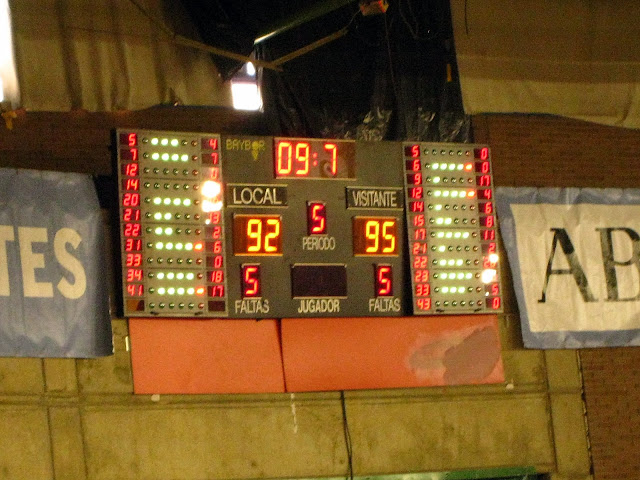
Seville's basketball team, sponsored by the local bank Cajesol are worse than the Raptors this year, with a record of 4-17 and expected relegation next year to an inferior league. However, when we saw them play Real Madrid, they came out in full force and took the game to double overtime before lowing 95-92. As you can tell from the sepia photo at the top of this post and the scoreboard above, this was a different experience than the NBA or even the O2 Arena in Berlin. Cajesol Sevilla plays in a small, 7,000 seat gym that is part of a large athletic complex about 15 minute from the city centre. While the facility was built in the 1980's, it looks like the basketball arena was built in the 1950's and hasn't been updated since. This is what Kristi and I thought an early NBA game would be like, with no Jumbotron, a very basic scoreboard (above) and concessions sold from folding tables outside the arena. Also, because the team is so bad this year they give away a large number of tickets for free to each game. Thankfully, that led to a jam packed arena and a really loud crowd, an asset to any sporting event. The free tickets also brought out a lot of families and teens, a rarity for basketball/hockey in Toronto when tickets are priced out of the range of most working families.

Also, Seville's team mascot is a bull, consistent with the bullfighting that is common in Spain (there is a 15,000 seat outdoor bull fighting arena right in the middle of downtown). This bull looks quite different than Chicago Bulls mascot Benny the Bull, but still, this seems like a knee-jerk reaction to the success of Michael Jordan and the "real" Bulls in the 1990's.


For those not that familiar with Spanish baksetball, the main league (the ACB) is said to present the highest level of competition outside of the NBA. We thoroughly enjoyed this game, including loving every aspect of the old-school arena, sitting in our free seats, eating sunflower seeds with the rest of the fans and cheering for the local team (and their horrible uniforms). We are definitely going to try to attend more ACB games during the rest of our Spanish adventure. PS: For those of you interested, the best player on the floor was Louis Bullock of Real Madrid.

Following the success of our basketball adventure, Kristi and I definitely wanted to make it to a football match during our Seville sojurn. There was a huge local derby taking place between Sevilla FC and Real Betis during our stay, however, tickets were too pricey and the weather was dodgy that day so we decided to avoid it. Instead, we decided to closely monitor the Spain v England friendly taking place on on February 11th and picked up tickets right when they went on sale for a very affordable 15 Euro apiece. Again, this pricing strategy (tons of tickets available from 10 - 20 Euro) may not have been profit maximizing but brought out a very loud and boistrous crowd filled with students and 20/30somethings. When Kristi and I showed up at the stadium before the match, it looked like we were joining a riot as there were beer bottles and broken glass everywhere, tons of people dressed in red and yellow cheering and a few brass bands wandering around playing some of the Spanish songs (not sure that the equivalent in Canada would be, but I just don't seem to think that "This Land is My Land" or "A Place to Stand a Place to Grow - Ontari-ari-ari-o!" would bring about the same passion.

As for the game itself, with the crowd on their side, Spain managed to outduel England 2-0 with the loudest cheers for Spanish hero David Villa as he scored in his 6th consecutive international match. The loudest boos (whistles in Spain) were saved for David Beckham, especially when he picked up a yellow card for arguing. He then continued to get jeered afterward everytime he touched the ball. The post-game celebration was a little bit tamer than the pre-game but definitely a great time.

Thursday, February 12, 2009

Cordoba

A few days ago, Kristi and I decided to take a day trip to Cordoba, which is about 1.5h by train from Seville (under 1h if you take the high speed train). Between 750 and 1200 A.D., Cordoba was the capital of Moorish Spain and one of the leading centres of Muslim art and learning. Cordoba's history also includes a very large Jewish population, which was decimated during the Spanish Inquisition.


Cordoba is best known for La Mezquita, the astonishingly large cathedral/mosque that stands at the heart of La Juderia, the old Jewish quarter of the city. The first iteration of La Mezquita was built by Abd ar-Rahman I, beginning in 786, on the remains of an old church. Subsequent rulers of the Spanish Moor empire added on to the building until it reached a capacity of 15,000 parishoners. La Mezquita is an architectural wonder as the interior consists of row upon row of marble columns, supporting perfectly constructed arches (seen in the photo above). When the Christians recaptured the city in the 13th century, they transformed La Mezquita into a cathedral, but thankfully did not destroy the original mosque. We were both mesmerized by the building.

Nearby La Mezquita, is the old Cordoba synagogue (above), one of only three that survived the Spanish Inquisition. The synagogue was built in 1315 and is extremely small (I would bet that it could hold a maximum of 50 people for prayers). A lot of the building was destroyed over the years; however, some of the original stucco and stonework remains, including some of the Hebrew text that surrounded the interior (as seen in the photo below).


We also toured a small museum nearby the Synagogue dedicated to the history and customs of Jews in Spain. It was interesting to compare some of the local customs to those practiced at family gatherings and on Jewish holidays in Toronto.

We also really just enjoyed wandering around Cordoba and seeing the city (additional photos posted here). It was perfect for a day trip and similar to some of the other smaller cities that we visited in Portugal. We had some great coffee and pastries, a light lunch and then headed back to Seville by train.